
DBS Chief Investment Office 3Q26 Insights: Power Play Key Investment Takeaways | Bahasa
Indonesia, 30 Jun 2026 - Recent events have forced investors to reassess long-held assumptions in portfolio construction. The past 18 months have revealed a widening gap between political expectations and policy outcomes, particularly on geopolitics, fiscal discipline, and inflation. Rather than easing global tensions and restoring fiscal prudence, the current US policy mix has contributed to elevated geopolitical risk, higher defence spending, and structurally wider deficits. These developments point to a more inflation-prone macro regime than markets currently price.
Geopolitical tensions, especially in the Middle East, have meaningful macro consequences. Prolonged conflict has raised the risk of higher-for-longer energy prices, with oil supply vulnerabilities increasingly evident amid falling inventories. At the same time, fiscal expansion tied to defence and industrial policy is reinforcing inflation tail risks. Against this backdrop, investor complacency on inflation appears misplaced.
Beyond energy, the AI investment boom is emerging as another near-term inflationary force. While AI promises productivity gains, it is probably true only from a longer-term perspective. The current phase is capex-intensive and supply-constrained. In the near term, the AI frenzy translates to higher inflation given the strong infrastructure buildup which pushes up the demand for everything from software and electronic parts to electricity consumption. In addition, China’s gradual exit from deflation is another driver of inflation, as price pressures stabilise on the back of anti-involution policies and rising commodity input costs due to the Iranian crisis.
These developments have compelled central bankers to adopt a more hawkish view. Recent signals from major central banks reflect this shift, with the Fed, ECB, and BOE all pivoting towards more hawkish or neutral stances. Market pricing is also increasingly pointing to the possibility of rate hikes by the end of this year.
The traditional 60/40 framework is increasingly challenged as equity-bond correlations remain elevated in inflationary regimes, supporting the case for new safe havens. With bonds no longer providing reliable downside protection, investors need alternative diversifiers. Gold has played this role effectively, but selective exposure to both commodities and China A-shares also offers diversification benefits, given their lower correlation with global equities.
At the same time, the global economy is entering a new capex supercycle, driven by a dual capex expansion phase: AI and energy. Hyperscalers continue to ramp spending aggressively as compute demand outpaces supply, while sovereign AI initiatives add a strategic layer to infrastructure investment. In energy, years of underinvestment and rising energy security concerns are catalysing renewed capex across the value chain. In this environment, we favour “pick-and-shovel” beneficiaries positioned to capture rising capex intensity, particularly semiconductor ecosystems, networking and specialised hardware, and oil services and equipment provider.
Key tactical call highlights
Cross Assets: Indifference
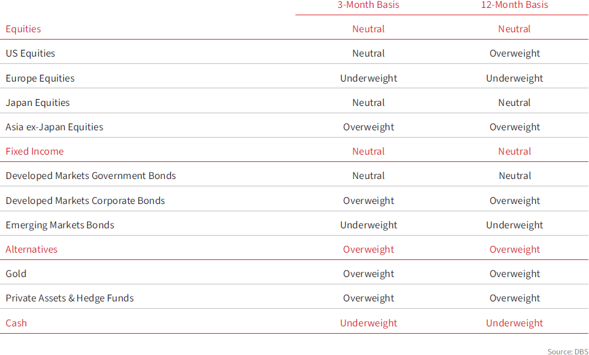
We suggest a broadly neutral stance on both equities and bonds. US growth remains resilient, underpinned by robust consumption, energy exports, and investment cycle, with AI related capex and Trump’s One Big Beautiful Bill Act lif ting sentiments. The Atlanta Fed GDPNow forecast have rebounded meaningfully, while inf lation risks are skewed to the upside and markets are beginning to price in eventual policy tightening. On corporate earnings, consensus is expecting robust global earnings growth in 2026 and 2027. From a valuation perspective, bonds appear more attractive relative to equities. Flow dynamics show balanced demand across both asset classes, although US equities continue to dominate regional allocation trends, driven by strong earnings delivery and sustained interest in AI linked sectors.
Equities: Momentum Reigns - Top-down country allocation matters less, while bottom-up selection matters more
Equity markets have been driven by strong momentum, with the sharp rally since end March catching investors off guard. While other asset classes remain focused on the Iranian crisis, equities were already pricing in a resolution to the crisis and a normalisation in oil prices. The rally has been narrow and largely led by AI related names, driving significant dispersion as momentum stocks outperform low volatility plays. We expect investors’ AI enthusiasm to remain supported by earnings, but advocate a barbell approach, pairing AI exposure with sectors less exposed to the technology. In addition, investors should favour businesses with low energy intensity, as higher-for-longer oil prices could pressure margins across energy sensitive sectors.
Bonds: Bond yields skewed to the upside; selectivity is key in EM credit.
The Middle East crisis, alongside macro resilience driven by AI-related capex, will keep inf lationary pressure elevated and reinforces expectations for further rate hikes across developed markets. As the global economy shifts f rom a savings glut to a capex driven regime, f low into corporate bonds could crowd out treasury space and push bond yields higher. In corporate credit, we maintain a preference for 5–7Y duration for bond portfolio. Within EM, selectivity remains critical, favouring markets that possess: (1) energy independence, (2) policy credibility, and (3) adequate risk compensation. Bottom-up discipline is also essential, with a focus on quality issuers that has strong fundamentals and capability to repay debt. We also see opportunities in AT1s, which stand to benefit f rom rising rates via
margin expansion.
Alternatives: Constructive on gold despite near-term inflation headwinds.
Gold has recently traded more like a risk asset due to crowded speculative positioning, resulting in volatility and profit taking. However, this phase is unlikely to persist, with gold expected to reassert its safe haven role. Rising inf lation presents a mixed outlook: (1) moderate inf lation alongside policy tightening may weigh on gold via higher real yields, while (2) an extreme inf lation scenario would support strong outperformance. Despite the medium-term inf lation headwinds, we maintain a constructive stance on gold given structural drivers like dedollarisation and monetary debasement . In private markets, widening dispersion driven by AI disruption and macro uncertainty reinforces the need for selectivity. Investors should focus on high quality managers and assets, and gain exposure to co-investments on high conviction deals, which offers later-stage opportunities in companies with resilient
earnings, faster return realisation, and f lexible capital deployment.
3Q26 Investment Summary
Macro
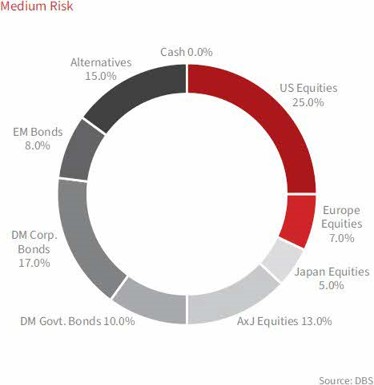
CIO AA Breakdown by Asset Class (Medium-Risk Profile)
Geopolitical tensions, especially in the Middle East, have meaningful macro consequences. Prolonged conflict has raised the risk of higher-for-longer energy prices, with oil supply vulnerabilities increasingly evident amid falling inventories. At the same time, fiscal expansion tied to defence and industrial policy is reinforcing inflation tail risks. Against this backdrop, investor complacency on inflation appears misplaced.
Beyond energy, the AI investment boom is emerging as another near-term inflationary force. While AI promises productivity gains, it is probably true only from a longer-term perspective. The current phase is capex-intensive and supply-constrained. In the near term, the AI frenzy translates to higher inflation given the strong infrastructure buildup which pushes up the demand for everything from software and electronic parts to electricity consumption. In addition, China’s gradual exit from deflation is another driver of inflation, as price pressures stabilise on the back of anti-involution policies and rising commodity input costs due to the Iranian crisis.
These developments have compelled central bankers to adopt a more hawkish view. Recent signals from major central banks reflect this shift, with the Fed, ECB, and BOE all pivoting towards more hawkish or neutral stances. Market pricing is also increasingly pointing to the possibility of rate hikes by the end of this year.
The traditional 60/40 framework is increasingly challenged as equity-bond correlations remain elevated in inflationary regimes, supporting the case for new safe havens. With bonds no longer providing reliable downside protection, investors need alternative diversifiers. Gold has played this role effectively, but selective exposure to both commodities and China A-shares also offers diversification benefits, given their lower correlation with global equities.
At the same time, the global economy is entering a new capex supercycle, driven by a dual capex expansion phase: AI and energy. Hyperscalers continue to ramp spending aggressively as compute demand outpaces supply, while sovereign AI initiatives add a strategic layer to infrastructure investment. In energy, years of underinvestment and rising energy security concerns are catalysing renewed capex across the value chain. In this environment, we favour “pick-and-shovel” beneficiaries positioned to capture rising capex intensity, particularly semiconductor ecosystems, networking and specialised hardware, and oil services and equipment provider.
Key tactical call highlights
Cross Assets: Indifference
We suggest a broadly neutral stance on both equities and bonds. US growth remains resilient, underpinned by robust consumption, energy exports, and investment cycle, with AI related capex and Trump’s One Big Beautiful Bill Act lif ting sentiments. The Atlanta Fed GDPNow forecast have rebounded meaningfully, while inf lation risks are skewed to the upside and markets are beginning to price in eventual policy tightening. On corporate earnings, consensus is expecting robust global earnings growth in 2026 and 2027. From a valuation perspective, bonds appear more attractive relative to equities. Flow dynamics show balanced demand across both asset classes, although US equities continue to dominate regional allocation trends, driven by strong earnings delivery and sustained interest in AI linked sectors.
Equities: Momentum Reigns - Top-down country allocation matters less, while bottom-up selection matters more
Equity markets have been driven by strong momentum, with the sharp rally since end March catching investors off guard. While other asset classes remain focused on the Iranian crisis, equities were already pricing in a resolution to the crisis and a normalisation in oil prices. The rally has been narrow and largely led by AI related names, driving significant dispersion as momentum stocks outperform low volatility plays. We expect investors’ AI enthusiasm to remain supported by earnings, but advocate a barbell approach, pairing AI exposure with sectors less exposed to the technology. In addition, investors should favour businesses with low energy intensity, as higher-for-longer oil prices could pressure margins across energy sensitive sectors.
Bonds: Bond yields skewed to the upside; selectivity is key in EM credit.
The Middle East crisis, alongside macro resilience driven by AI-related capex, will keep inf lationary pressure elevated and reinforces expectations for further rate hikes across developed markets. As the global economy shifts f rom a savings glut to a capex driven regime, f low into corporate bonds could crowd out treasury space and push bond yields higher. In corporate credit, we maintain a preference for 5–7Y duration for bond portfolio. Within EM, selectivity remains critical, favouring markets that possess: (1) energy independence, (2) policy credibility, and (3) adequate risk compensation. Bottom-up discipline is also essential, with a focus on quality issuers that has strong fundamentals and capability to repay debt. We also see opportunities in AT1s, which stand to benefit f rom rising rates via
margin expansion.
Alternatives: Constructive on gold despite near-term inflation headwinds.
Gold has recently traded more like a risk asset due to crowded speculative positioning, resulting in volatility and profit taking. However, this phase is unlikely to persist, with gold expected to reassert its safe haven role. Rising inf lation presents a mixed outlook: (1) moderate inf lation alongside policy tightening may weigh on gold via higher real yields, while (2) an extreme inf lation scenario would support strong outperformance. Despite the medium-term inf lation headwinds, we maintain a constructive stance on gold given structural drivers like dedollarisation and monetary debasement . In private markets, widening dispersion driven by AI disruption and macro uncertainty reinforces the need for selectivity. Investors should focus on high quality managers and assets, and gain exposure to co-investments on high conviction deals, which offers later-stage opportunities in companies with resilient
earnings, faster return realisation, and f lexible capital deployment.
3Q26 Investment Summary
Macro
- US
US data trends and political pressure could push the Warsh-led FOMC in opposing directions. Strong US economic data and heightened inf lation concerns should point to the Fed’s case to hold or even lean hawkish. We have dropped our 2026 rate cut calls but have yet to venture into 2027 hiking calls.
- Eurozone
The stagflationary shock arising f rom the Middle East conflict is likely to affect the Eurozone more than the US. We have lowered our 2026 growth forecast to 1.0%, while raising our inf lation forecast to 3.1%. The ECB is expected to stay cautious and hawkish.
- Japan
We maintain our GDP and inf lation forecasts for Japan. Fiscal expansion, BOJ policy normalisation, robust wage growth, and buoyant semiconductor exports should support the economy despite ongoing risk related to the Middle East conflict.
- Asia
Asian exports and GDP remain resilient, buoyed by robust demand for AI-driven electronics and green tech, defying energy shock. South Korea and Taiwan are seeing exceptional export growth, while Malaysia, Singapore, and Vietnam are also ascendent.
- US
S&P 500 remains highly concentrated and historically, such narrow up -moves preceded higher volatility. Surging bond yields and rising volatility are potential headwinds for expensively valued growth stocks. Balance exposure to US momentum plays with defens ive names.
- Europe
While near-term risks f rom inf lation, bond yields, and geopolitical uncertainty remain elevated, Europe continues to offer selective alpha opportunities. Market leadership is increasingly driven by earnings certainty, structural capex exposure, and energy security themes.
- Japan
Sector performance divergence is likely to intensify given elevated valuations and f iscal risks driving bond yields higher. Structural winners supported by strategic investments and corporate reforms should outperform.
- Asia ex-Japan
Asia ex-Japan equities hold f irm amid geopolitical and energy shocks, supported by AI-led capex, benign inf lation, and improving policy. Selective reacceleration is driven by North Asia technology, China’s strategic industries, and income opportunities in Singapore and Hong Kong.
- Investment Grade
IG returns will continue to be driven more by carry than spread compression. Stay with high-quality (A/BBB) issuers with a portfolio duration of 5-7Y, complemented by Liquid+ strategy (2-3Y) as a cash alternative for f ront-end carry and liquidity. AT1s may benefit f rom curve-steepening, while TIPS remain a favourite pick to hedge stagflation risks.
- High Yield
Tight spreads leave little margin for error amid rate uncertainty and wide sector dispersion. We prefer higher quality issuers with resilient balance sheets to withstand uncertainty over reaching down for yield.
- Global
The Middle East conflict introduced inf lation worries at a time when the global economy is largely resilient. Rate hikes may be considered amid price pressures.
- Asia
Stresses on Asia rates have become evident as central banks grapple with rising inf lation, currency weakness, and a potential conflict of objectives.
- US Dollar Index
The US-Iran conflict triggered a new macroeconomic landscape. The US economy is navigating this new reality much better than other economic blocs, resulting in a return of US exceptionalism. This supports the moderately stronger USD in 3Q26.
- G7
EUR and GBP to underperform within the G10 space as Europe remains most vulnerable to elevated energy prices. JPY weakness appears more enduring. AUD and NZD are better positioned to outperform as they benefit f rom yield advantage and f irmer commodity comp lex.
- Asia
PBOC has been tolerant of persistent RMB strength. However, it may have reached a tipping point as the RMB Index approaches cycle highs. SGD will track broad USD prospects, while the performance of other Asian currencies will depend on their exposure to energy prices.
- Private Equity
Private equity returns will continue to diverge across managers and companies. We favour co - investments alongside top-tier managers, allowing investors to gain exclusive access to high-conviction deals in order to capture excess returns amid rising dispers ion.
- Private Credit
Private credit’s f loating-rate income can buffer against rate uncertainty, but quality is paramount. Select senior-secured f irst-lien strategies with top-tier managers, avoiding subordinated or unitranche risk with weaker structural protections
- Hedge Funds
Hedge funds remain essential portfolio stabilisers as stock-bond diversification weakens. Their f lexibility to short, and exploit macro or arbitrage dislocations supports capital preservation, downside protection, and alpha generation through volatile regimes.
- Gold
While the Iran War and heightened inf lation risk will weigh on gold in the short to medium term, signs of stabilisation and recovery have begun to emerge. The long -term outlook remains robust on the back of intensified de-dollarisation and monetary debasement risks.
- Commodities
Escalation in Iran has shifted energy markets into a regime of physical tightness. Implications for industrial metals and agricultural commodities also positive but more nuanced. In the long term, rising resource nationalism, alongside AI-driven energy intensity and electrification will benefit select commodities.
CIO AA Breakdown by Asset Class (Medium-Risk Profile)
Useful Links
Awards
World's Best Bank 2025, 2018 - 2022
Euromoney, Global Finance, The Banker
Asia’s Safest Bank, 2009 – 2025
Global Finance
